
LECTURE ON “ACADEMIC INTEGRITY” FOR HIGHER EDUCATION STUDENTS IN THE FACULTY OF ENGINEERING AND INFORMATION TECHNOLOGIES
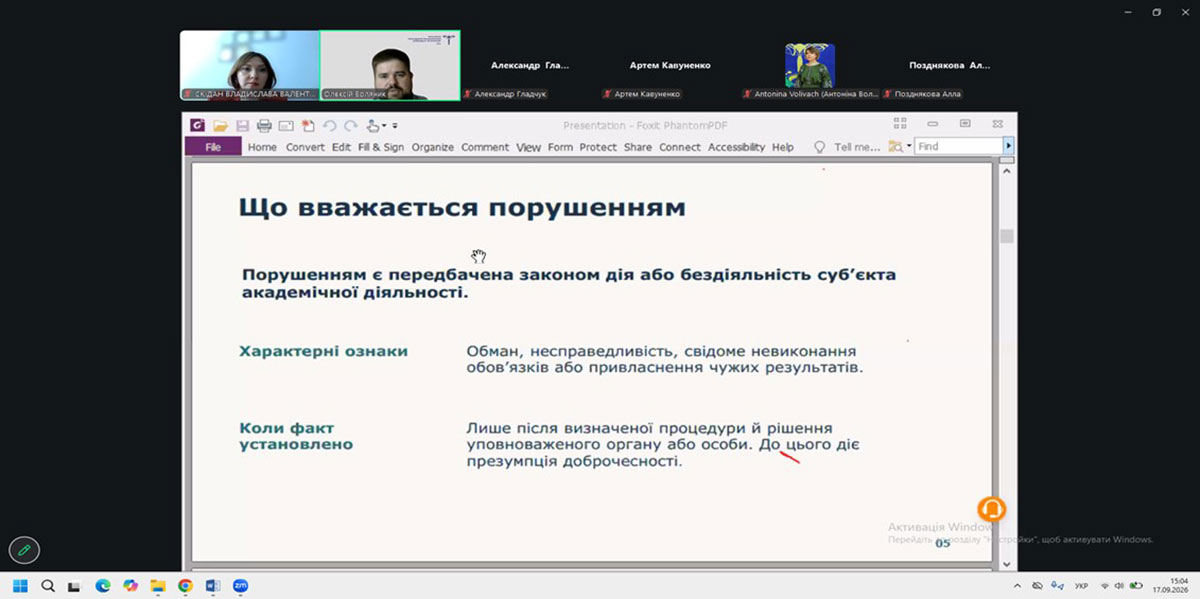
On September 17, 2026, a lecture titled “Academic Integrity: Concepts, Types of Violations, and Accountability” was held for students in the Faculty of Engineering and Information Technology at Kyiv National University of Technologies and Design.
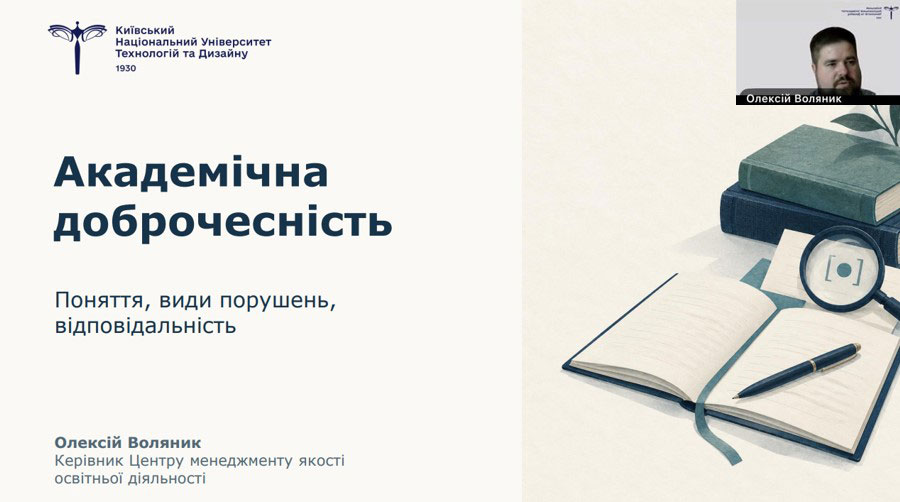
The lecture was given by Oleksii VOLIANYK, director of the Center for Quality Management in Education at KNUTD.
The event was attended by students enrolled in the Faculty of Engineering and Information Technology’s first-cycle (bachelor’s) degree programs in the following majors: E6 Applied Physics and Nanomaterials, F2 Software Engineering, F3 Computer Science, F7 Computer Engineering, G3 Electrical Engineering, G7 Automation, Computer-Integrated Technologies, and Robotics, G9 Applied Mechanics, G11 Mechanical Engineering (by specialization), as well as students in the second (master’s) level of higher education in the following specializations: F2 Software Engineering, F3 Computer Science, F7 Computer Engineering, G3 Electrical Engineering, G7 Automation, Computer-Integrated Technologies, and Robotics, G11 Mechanical Engineering (by specialization).
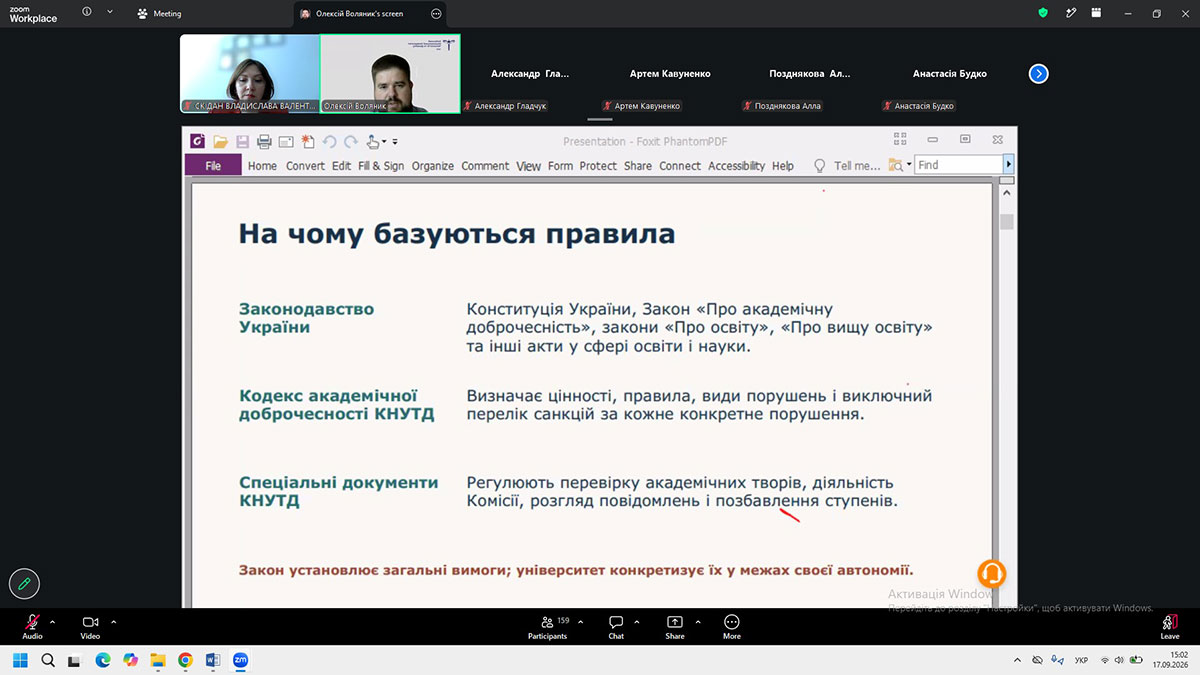
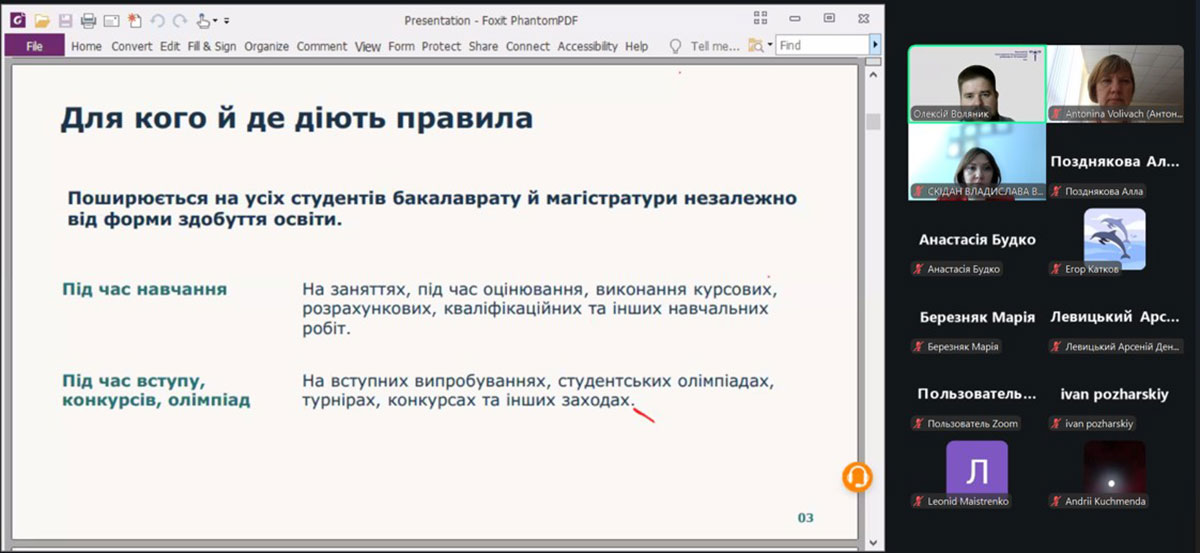
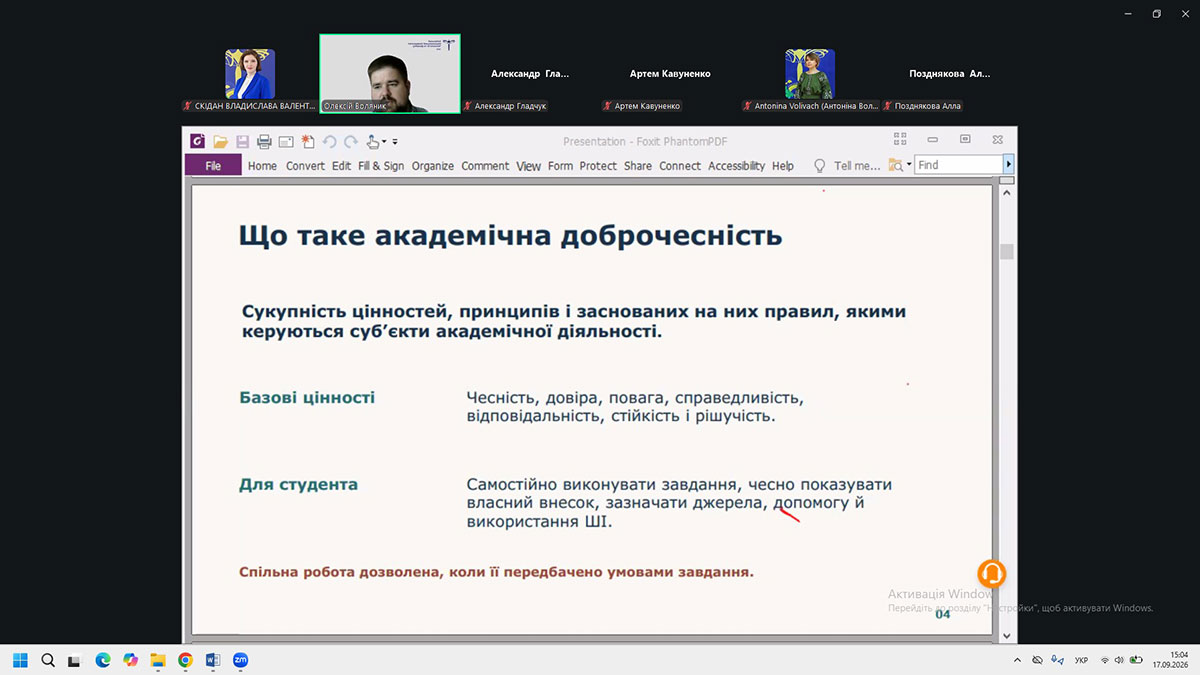
During the lecture, special attention was paid to understanding academic integrity as a set of values, principles, and rules that participants in academic activities should follow. The discussion focused on such fundamental values as honesty, trust, respect, fairness, responsibility, resilience, and determination. For students, adhering to these principles entails completing assignments independently, honestly presenting their own work, properly citing sources used and assistance received, and using artificial intelligence technologies.
A significant portion of the meeting was devoted to types of academic integrity violations and the consequences for them. The students gained a more detailed understanding of the concepts of academic plagiarism, misattribution and misrepresentation of authorship, self-plagiarism, fabrication and falsification of data, non-independent completion of assignments, providing unauthorized assistance, academic sabotage, and incitement to violate academic integrity. Particular emphasis was placed on the need to distinguish between fabrication the invention of data or facts and falsification, that is, the deliberate distortion of existing data.
A separate section of the lecture was devoted to academic plagiarism and the rules for the proper use of other authors’ work. Practical examples were used to demonstrate that academic plagiarism can involve not only text but also program code, diagrams, designs, data, models, methods, projects, and other products of intellectual activity. Verbatim quotations must be accompanied by citations and references; paraphrasing someone else’s ideas in one’s own words requires a reference to the source; and the use of images, diagrams, source code, or models requires attribution, a source citation, and compliance with the relevant terms of use.
The issue of the ethical use of artificial intelligence sparked particular interest among students pursuing degrees in engineering and IT. During the lecture, it was emphasized that texts, images, program code, models, data, or other results generated using AI should not be presented as entirely original work unless the use of the relevant tool is explicitly stated. At the same time, simply declaring the use of AI does not automatically grant permission to use it: the requirements of the specific academic assignment must be taken into account.
For future professionals in software engineering, computer science, computer engineering, automation, electrical engineering, applied mechanics, mechanical engineering, applied physics, and nanomaterials, these issues are of particular practical importance. Academic integrity in the relevant educational components applies not only to writing papers but also to the independent creation of program code, algorithms, models, diagrams, drawings, simulation results, experimental and computational data, and software and engineering projects.
Significant attention was paid to students’ thesis projects and the consequences of violating academic integrity during their preparation. The lecture materials noted that if a violation is established prior to the awarding of a degree, it may serve as grounds for denying the degree, while a violation established after the degree has been awarded may result in consequences prescribed by law. It was specifically emphasized that it is unacceptable to submit a thesis that was commissioned or received from another person as one’s own.
Students also received practical guidance on how to check written assignments for signs of academic plagiarism and other violations. The review may cover qualifying papers, term papers, internship reports, computational and graphical assignments, explanatory notes, abstracts, essays, and other written work. However, a software-generated match rate for text similarities is not, in and of itself, automatic proof of academic plagiarism: a substantive analysis of the nature of the borrowings, the correctness of their citation, and other circumstances is required.
A key focus of the meeting was the understanding that academic integrity is not merely a system of prohibitions and accountability, but the foundation of a future professional’s work ethic. For engineers, programmers, researchers, or developers, the principles of integrity are directly linked to data reliability, the reproducibility of results, respect for intellectual property, the responsible use of digital technologies, and trust in the outcomes of professional activities.
Holding such meetings helps foster a culture of academic responsibility, independence, critical thinking, and a conscious attitude toward the results of their own educational, scientific, project-based, and research activities among students in the Faculty of Engineering and Information Technology.
We sincerely thank Oleksii VOLIANYK, Director of the Center for Quality Management in Education at KNUTD, for his informative, relevant, and practice-oriented lecture, his thorough explanations, and his important contribution to fostering a culture of academic integrity among students of the Faculty of Engineering and Information Technology!
28.09.2026