
GUEST LECTURE BY ROSTISLAV GOLOBORODKO, DIRECTOR OF RENDER GROUP, FOR MASTER’S STUDENTS IN THE F2 SPECIALIZATION “SOFTWARE ENGINEERING”
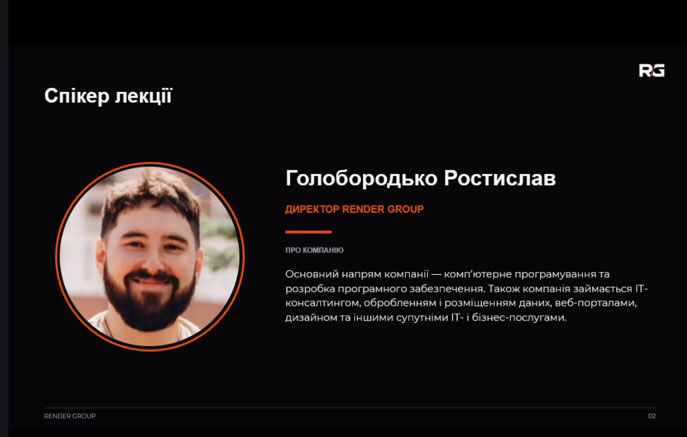
On October 12, 2026, as part of the mandatory educational component OK 1, “Software Development Methodology with Fundamentals of Intellectual Property,” of the “Software Engineering for Intelligent Systems” educational and professional program at the second (master’s) level of higher education, a guest online lecture on the topic “Standardization and Regulatory Framework for Software Development.” The speaker at the event was Rostislav GOLOBORODKO, director of RENDER GROUP.
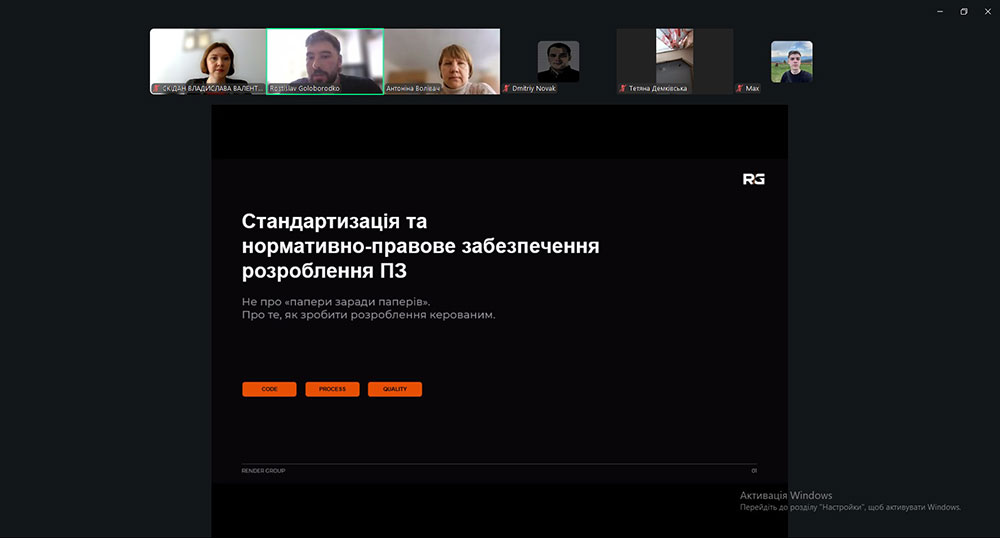
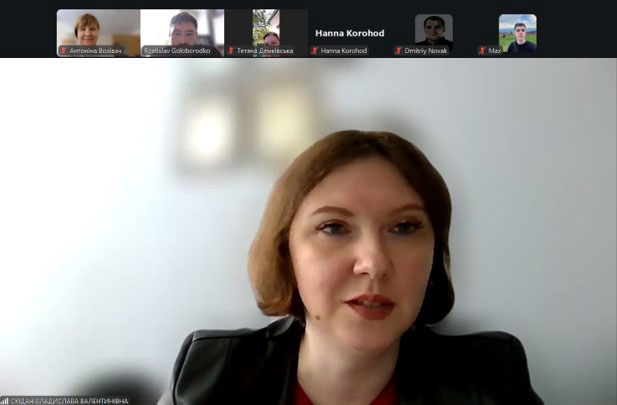
The event was attended by faculty members and students from the Department of Information and Computer Technologies at Kyiv National University of Technologies and Design. The guest online lecture was moderated by Vladyslava SKIDAN, Head of the Department of Information and Computer Technologies, Candidate of Technical Sciences, and Associate Professor.
At the beginning of the meeting, Rostislav GOLOBORODKO briefed the participants on RENDER GROUP’s main areas of activity, including computer programming and software development, IT consulting, data processing and hosting, web portal development, and design. This helped to outline the practical context of the lecture’s topic and demonstrate the importance of engineering approaches in the professional work of IT specialists.
The speaker focused primarily on the role of standards in software development and their importance for effective teamwork. He emphasized that the use of standards creates a common foundation for collaboration among developers, helps align requirements, reduces risks, and prevents unforeseen situations at various stages of a software product’s life cycle.
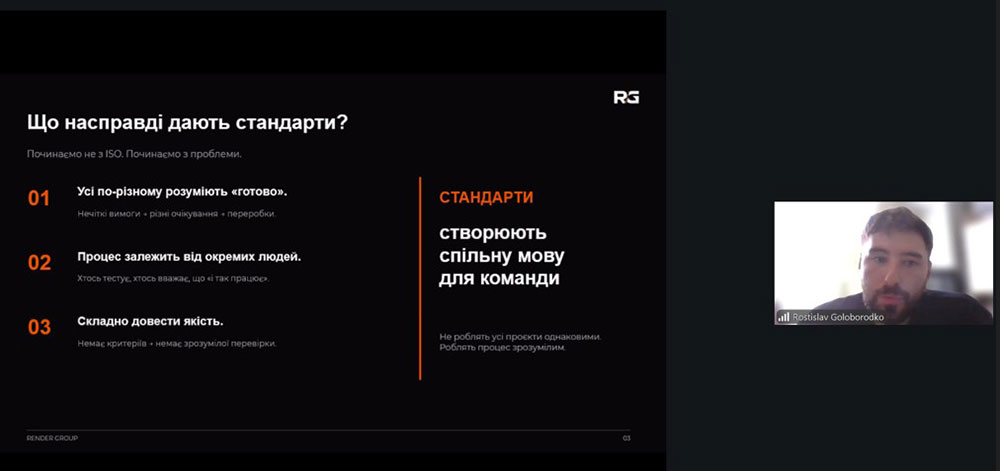
At the same time, it was noted that standards do not make all projects identical they ensure clarity, consistency, and manageability in development processes, while still allowing for the selection of solutions tailored to the specifics of a particular project.
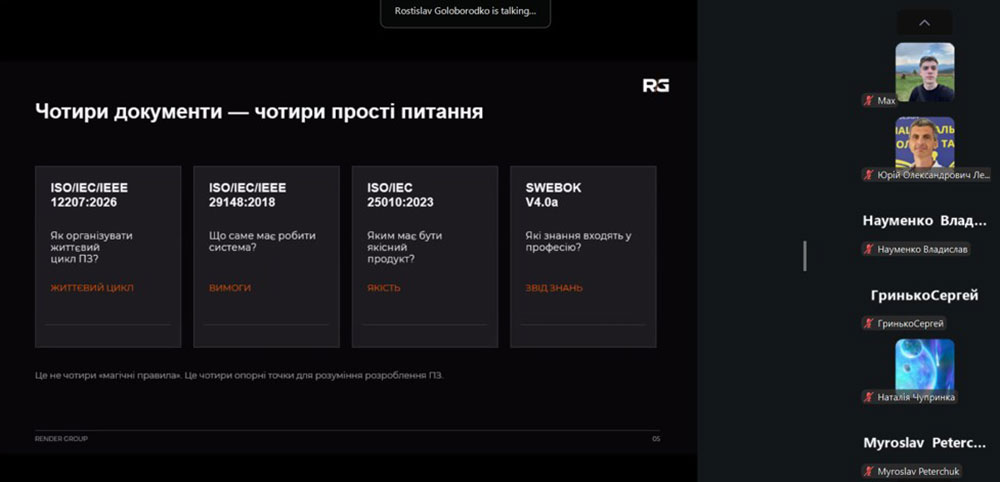
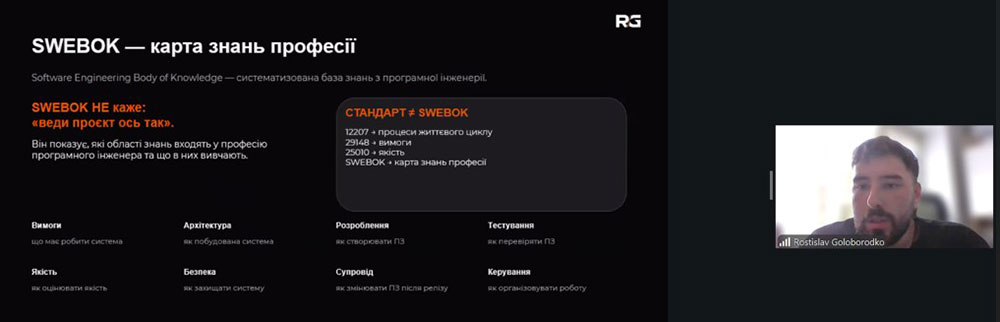
During the lecture, attendees were introduced to four key standards and sources of professional knowledge in the field of software engineering: ISO/IEC/IEEE 12207 (software life cycle processes) defines software life cycle processes and approaches to organizing work at various stages of software development and maintenance; ISO/IEC/IEEE 29148 (system and software requirements engineering) defines approaches to requirements engineering, including the formulation, analysis, documentation, and verification of requirements; ISO/IEC 25010 (software product quality model) describes a software product quality model and the characteristics used to assess its conformity with established requirements; SWEBOK (Software Engineering Body of Knowledge) systematizes the main areas of knowledge in software engineering and helps develop a comprehensive understanding of professional software development practices.
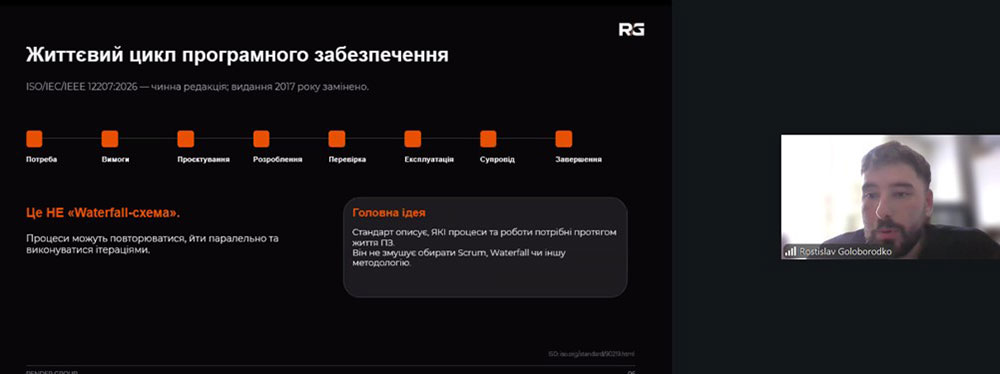
The theoretical material was supplemented by a discussion of the software life cycle from the conception of an idea and the identification of customer needs to the design, development, testing, deployment, and ongoing maintenance of the software product. The speaker highlighted the interconnection between these stages: errors or ambiguities made during the requirements gathering phase can lead to problems in architecture, software implementation, and testing, while shortcomings during deployment can negate the results of the team’s previous work.
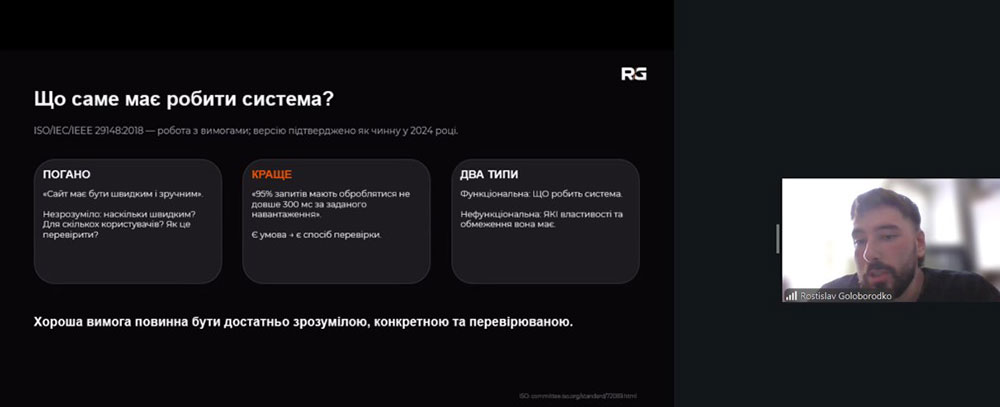
The participants discussed approaches to formulating clear, verifiable requirements, the specifics of system architecture design, testing levels, the organization of change control, version management, and the preparation of software releases. Special emphasis was placed on the need for requirements traceability the ability to establish a connection between customer needs, technical solutions, implemented features, and test results. This approach helps the team verify that the software product actually fulfills its intended tasks and identify discrepancies in a timely manner.
Special attention was paid to the regulatory and legal aspects of software development, including copyright, open-source software licensing, personal data protection, and contractual relationships with clients. These issues demonstrated that a developer’s professional responsibility extends not only to the technical correctness of the software code but also to compliance with legal requirements, the terms of use for third-party components, and obligations to users and clients.
Ariane 5 reuse of source code without verifying assumptions. A key part of the meeting was the analysis of five well-known cases from the practice of software system development and operation, which allowed participants to examine the consequences of engineering errors and violations of quality assurance processes.
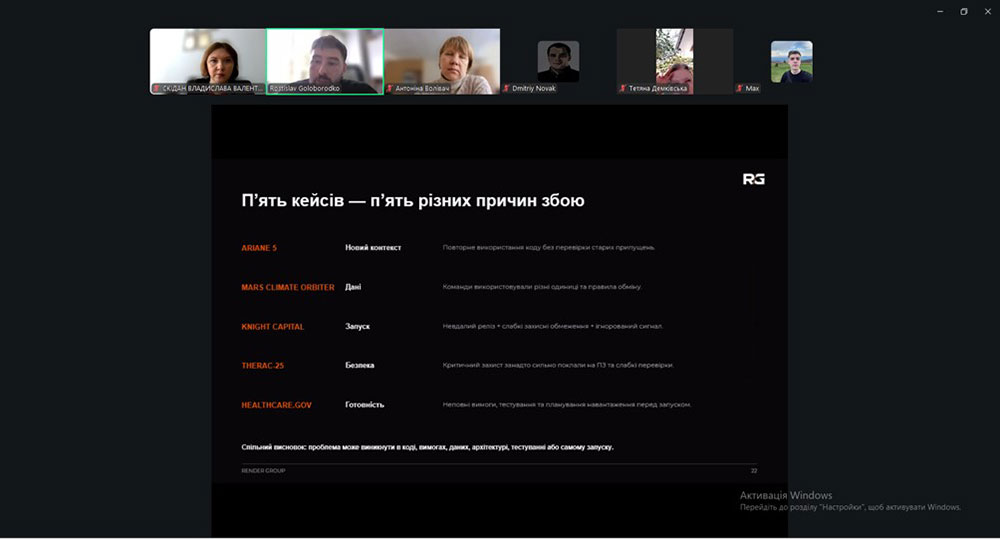
Using the Ariane 5 launch vehicle accident as an example, the speaker highlighted the importance of properly defining requirements and testing software components in a new environment. He discussed why software code that worked in a previous system is not necessarily safe to reuse without further analysis. It is important not only to define exactly what the system should do under specific conditions, but also to anticipate its behavior in boundary and abnormal situations, verify the permissible ranges of values, and define error-handling mechanisms.
Mars Climate Orbiter errors caused by inconsistencies in units of measurement between teams. Participants discussed the importance of establishing common agreements on data formats, units of measurement, and communication interfaces.
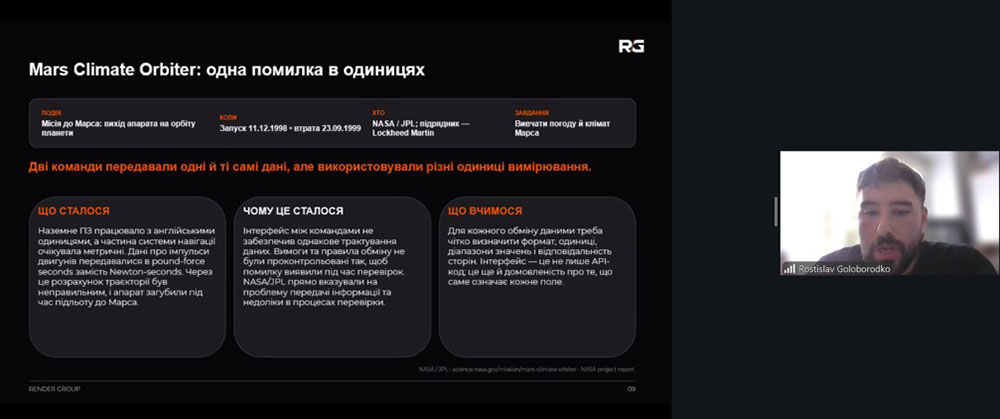
Particular attention was paid to the need to verify not only individual components but also the correctness of data exchange between them, and to use automated checks, integration tests, and end-to-end compliance verification. The team must clearly understand the assumptions underlying each component and how their consistency is verified.

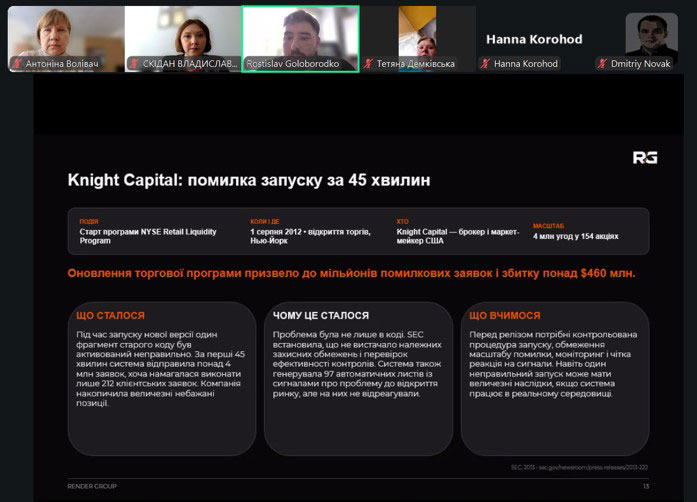
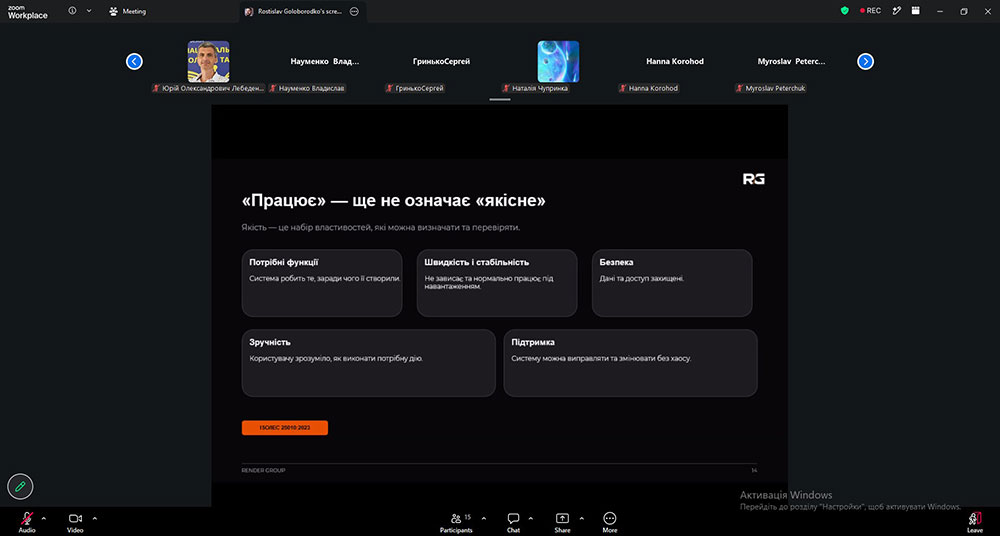
Knight Capital is all about change control and software quality. Using the example of an incident involving the incorrect deployment of a software update, the speaker highlighted the importance of version management, configuration control, verification of deployment procedures, and ensuring the system is ready for operation. It was emphasized that the fact that software works does not necessarily mean it is of adequate quality. A product may perform its basic functions but still have shortcomings in reliability, security, performance, or maintainability.
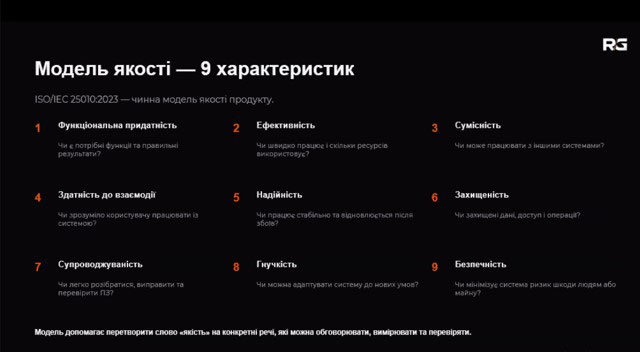
In this context, the software product quality model defined by the ISO/IEC 25010 standard was discussed. The speaker emphasized the need to evaluate software based on a set of characteristics, rather than merely on whether it launches or performs specific functions. This approach makes it possible to identify risks that might go unnoticed during a superficial review and to reasonably determine the acceptance criteria for a software product.
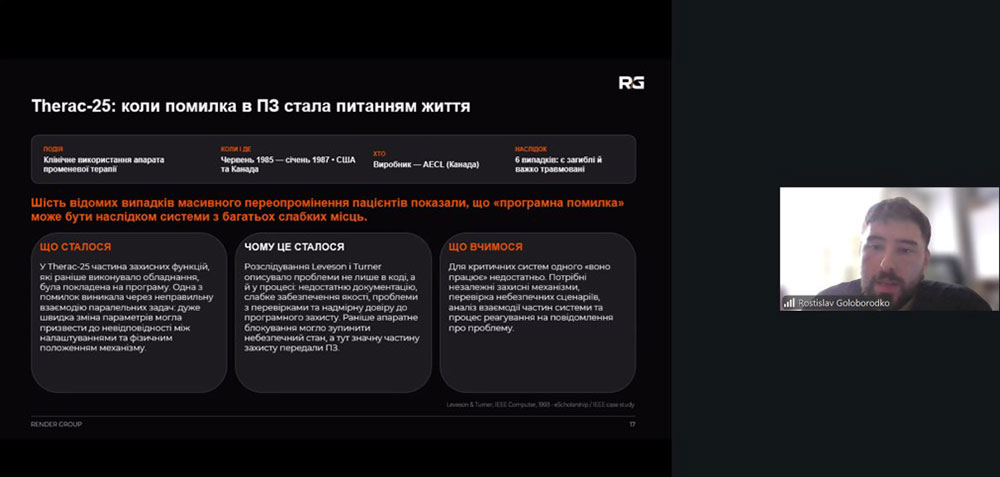
Therac-25 exemplifies safety as an integral part of the development process. An analysis of this case provided an opportunity to discuss the consequences of inadequate consideration of safety mechanisms in software-controlled systems. Emphasis was placed on the need to consider hazardous scenarios as early as the requirements definition and design phases, to provide for verification of critical operations, handling of abnormal situations, and independent protection mechanisms. It is particularly important that in systems where errors can endanger human life and health, safety must be systematically verified throughout the entire life cycle, not just before the product is released.
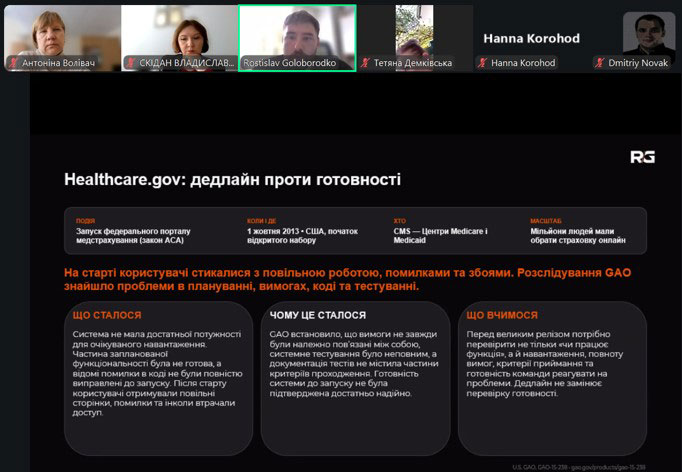
Healthcare.gov exemplifies implementation readiness and comprehensive testing. Using the launch of this large-scale digital platform as an example, participants examined the risks that arise when implementation deadlines take priority over verifying the system’s technical readiness. The discussion covered the importance of integration and load testing, component interoperability testing, performance evaluation, and advance preparation for the expected number of users. It was emphasized that the successful completion of individual modules does not guarantee the stable operation of the entire software product under real-world operating conditions.
In the concluding part of the lecture, the speaker emphasized that software reliability and quality are the result of comprehensive work on a project from defining requirements and designing the architecture to data validation, testing, and product deployment. The examples of IT incidents discussed demonstrated that even errors that seem minor at first glance or a lack of coordination among team members can lead to serious consequences.
Separately, Rostyslav HOLOBORODKO highlighted the practical value of SWEBOK as a systematic body of knowledge in software engineering that covers key professional practices and helps integrate technical solutions with organizational and management processes. This approach fosters a holistic understanding of software development as a sequential engineering process in which not only the product’s functionality but also its quality, security, maintainability, and compliance with specified requirements are crucial.
The Department of Information and Computer Technologies at Kyiv National University of Technologies and Design extends its sincere gratitude to Rostyslav HOLOBORODKO, Director of RENDER GROUP, for delivering an informative guest lecture, presenting current professional practices in the field of standardization and regulatory frameworks for software development, as well as for his significant contribution to deepening the professional knowledge and developing the professional competencies of higher education students. We greatly appreciate your willingness to share practical experience, support educational initiatives, and help strengthen collaboration between the academic community and representatives of the IT industry.
14.10.2026