
ACADEMIC STAFF AND STUDENTS OF THE DEPARTMENT OF MARKETING PARTICIPATED IN AN INTERNATIONAL LECTURE BY A STOCKHOLM SCHOOL OF ECONOMICS PROFESSOR AS PART OF REINFORCEUA
On November 11, 2026, academic staff and students of the Department of Marketing participated in an international online lecture entitled “From Lab to Market: Turning Knowledge into Innovation and Business”, held as part of the ReinforceUA educational initiative in partnership with the Academy of Management. The guest speaker was Valentina Tartari, Professor of Innovation and Sustainable Business at the Stockholm School of Economics (Sweden) and Director of the Jacob and Marcus Wallenberg Center for Innovative and Sustainable Business Development. She is a distinguished researcher specializing in innovation management, academic entrepreneurship, and university–industry collaboration.
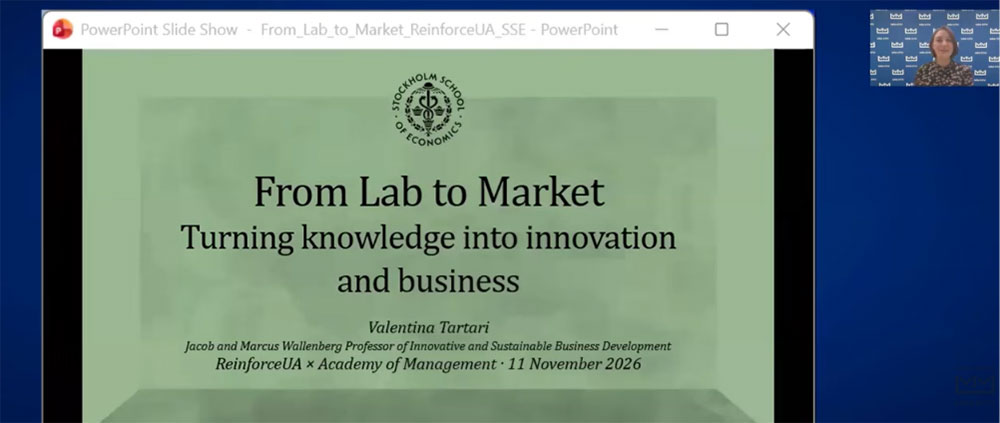
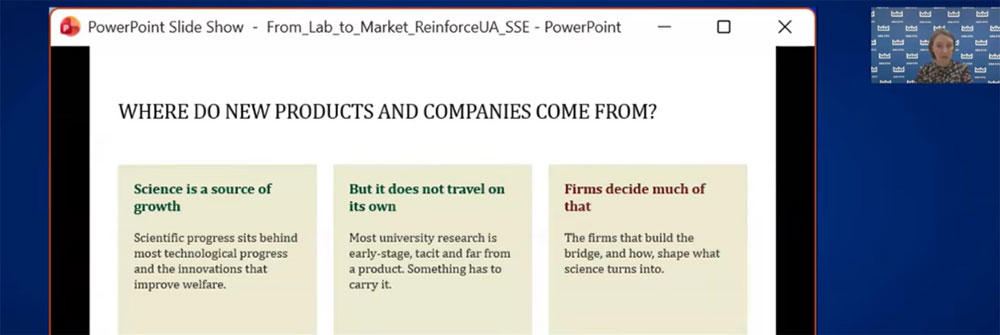
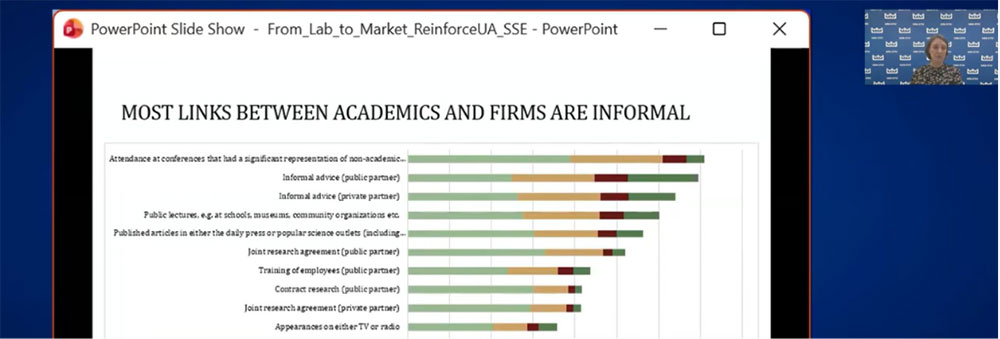
The lecture addressed key issues related to translating scientific knowledge into innovative products, technologies, and business solutions, mechanisms of interaction between academia and industry, and the role of research universities in fostering startups and developing regional innovation ecosystems. One of the central topics was the origin of new products and companies and the role of science in this process. Professor Tartari highlighted the fundamental importance of scientific progress as a driver of economic growth, technological advancement, and societal well-being. At the same time, she emphasized that scientific knowledge does not automatically translate into marketable innovations. A substantial proportion of university research remains at an early stage of development and is still far from becoming commercially viable products. In this context, businesses play a particularly important role in bridging the gap between scientific research and market needs. Companies largely determine which research outcomes can be put into practice, how they can be adapted to consumer demands, and whether they can be transformed into competitive products and services. Professor Tartari also devoted considerable attention to the nature of interactions between researchers and industry representatives. The research findings presented during the lecture demonstrated that most connections between academia and businesses are informal. Common forms of such interaction include participation in academic conferences attended by industry representatives, professional consulting, the exchange of expert knowledge, public lectures, the dissemination of research findings through popular science publications, and professional networking. At the same time, formal mechanisms of collaboration remain essential, including joint research projects, contract research, industry-oriented professional training, and the implementation of scientific and technological initiatives. This perspective demonstrates that effective knowledge transfer extends beyond patenting and the commercialization of research outcomes. It also depends heavily on continuous information exchange, professional networks, and long-term cooperation between researchers and entrepreneurs.
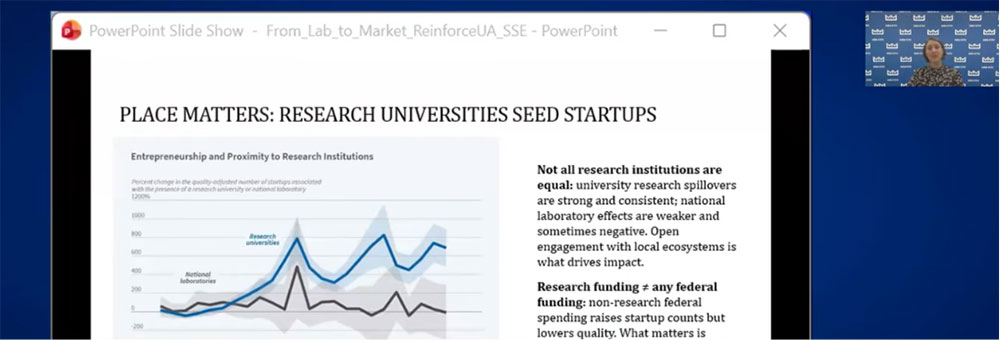
Attention was given to the role of research universities in fostering startups and entrepreneurial activity. The research findings presented during the lecture indicated that geographical proximity to universities contributes to the emergence of innovative companies, whereas the impact of other types of research institutions may be less straightforward. Key factors driving innovation include open innovation ecosystems, collaboration among researchers, entrepreneurs, and investors, and effective knowledge exchange. Issues related to the commercialization of scientific research and its adaptation to market needs were also of particular interest. Successfully transforming scientific knowledge into competitive products requires not only technological solutions but also market research, an understanding of consumer needs, an assessment of market opportunities, the development of a compelling value proposition, and effective marketing and promotional strategies. It is the combination of scientific potential and marketing expertise that creates favorable conditions for successfully bringing innovative products to market. For Ukraine, the issues addressed during the lecture are particularly relevant in the context of innovation-driven economic development and post-war recovery. University-industry collaboration, support for academic startups, and the practical application of research outcomes contribute to economic modernization and enhance the competitiveness of Ukrainian enterprises. Participation in the lecture provided a valuable learning experience for the academic staff and students of the Department of Marketing, deepening their understanding of technology transfer, innovation commercialization, and the practical application of scientific research. Exposure to international experience creates new opportunities for professional development, encourages student research activities, and fosters innovative thinking among future marketing professionals.
The Department of Marketing at Kyiv National University of Technologies and Design (KNUTD) extends its sincere gratitude to Oleksii Vynohradov, Acting President of MIM Business School, and the entire MIM Business School team for their longstanding and productive partnership, continued support of educational initiatives, and the opportunity to participate in the international ReinforceUA lecture series.
This collaboration facilitates the integration of contemporary scientific knowledge into the educational process, strengthens professional competencies, and promotes international academic cooperation.
16.11.2026