On December 22, 2025, a meeting was held to address the challenges of training specialists for Ukraine’s pharmaceutical sector and the growing shortage of qualified personnel. The event took place within the framework of the Healthcare and Pharmacy Committee of the Ukrainian Chamber of Commerce and Industry (UCCI) and brought together representatives of higher education institutions, professional associations, the expert community, and sectoral self-governing bodies. The UCCI served as a communication and coordination platform for professional dialogue between education, business, and the professional community, aimed at developing coordinated proposals to overcome the staffing crisis and to shape an effective state policy for pharmaceutical workforce development.
The meeting was opened with a welcoming address by Oleksandra Olshanska, Acting Rector of the Kyiv National University of Technologies and Design (KNUTD), who emphasized that the shortage of personnel in the pharmaceutical sector has become systemic and critical and requires urgent decisions at the level of state educational policy. She stressed the importance of consolidating efforts among universities, professional associations, and public authorities to preserve the human capital of the industry.

The meeting was moderated by Vladyslav Strashnyi, Head of the Department of Industrial Pharmacy at KNUTD and Chair of the Healthcare and Pharmacy Committee of the UCCI. In his remarks, he noted that the combination of a high admission threshold, demographic losses, martial law conditions, and the outflow of young people abroad has led to a sharp decline in enrollment in pharmaceutical specialties. This trend poses a threat not only to the education system but also to the stable functioning of the pharmaceutical sector as a whole.
Representatives of leading higher education institutions and professional organizations took part in the discussion.
Tetiana Derkach, Dean of the Faculty of Chemical and Biopharmaceutical Technologies, emphasized that assessment of students’ professional readiness should take place during the learning process rather than through excessively strict admission barriers.
Olena Roik, Associate Professor of the Department of Industrial Pharmacy and Member of the Scientific and Methodological Commission on Healthcare and Social Welfare, Subcommittee I8 “Pharmacy,” of the Higher Education Sector of the Scientific and Methodological Council of the Ministry of Education and Science of Ukraine, drew attention to the need to reduce the admission threshold and to temporarily revise entry requirements under martial law conditions. She emphasized that maintaining the current restrictions exacerbates the personnel shortage and weakens the sector’s capacity in the medium term.
Systemic aspects of the problem were outlined by Oleksandr Kukhtenko, Rector of the National University of Pharmacy, who stressed that the currently high admission threshold does not correspond to the actual content of education in the specialty “Pharmacy” (by specializations), whose graduates do not perform direct medical interventions. He also pointed to the sharp decline in the number of applicants in recent years and the need to revise the state approach to admission rules.
Iryna Hubytska, Deputy Head of the Department of Technologies of Biologically Active Compounds, Pharmacy and Biotechnology at Lviv Polytechnic National University, and Secretary of the Scientific and Methodological Commission on Healthcare and Social Welfare, Subcommittee I8 “Pharmacy,” provided examples of a significant reduction in student enrollment in pharmaceutical programs, particularly in integrated master’s programs, which poses a risk to the continuity of professional training.
Nataliia Sholoiko, Associate Professor of the Department of Organization and Economics of Pharmacy at Bogomolets National Medical University, emphasized that a high admission score alone does not guarantee the quality of professional training and highlighted the importance of considering subject-specific disciplines when forming the results of the National Multidisciplinary Test (NMT).
Iryna Suvorova, Director of the Public Union “Pharmacy Professional Association of Ukraine,” reported on appeals submitted by professional organizations to the Ministry of Health and the Ministry of Education and Science requesting a revision of admission requirements for pharmaceutical specialties. She stressed the need for a consolidated position of educators and employers.
Olena Omelchuk, Director of the NGO “Association of Pharmacists of Ukraine,” drew attention to the legal aspects of the issue, noting that an excessively high admission threshold effectively restricts citizens’ right to higher education and encourages applicants to pursue education abroad.
Larysa Prosyanyk, Chair of the Board of the Vinnytsia Regional Pharmacists Association “Cum Deo,” emphasized the intensification of the staffing crisis due to professional migration and the declining prestige of the profession, as well as the need to establish a system of professional support for pharmacists.
Mykhailo Shumilin, Secretary of the Healthcare and Pharmacy Committee of the Ukrainian Chamber of Commerce and Industry, raised the issue of the absence of sectoral collective agreements in Ukraine, which could serve as instruments of social protection and motivation for employees in the pharmaceutical sector.
Vira Lubenets, Head of the Department of Technologies of Biologically Active Compounds, Pharmacy and Biotechnology at Lviv Polytechnic National University, proposed expanding access to the specialty “Pharmacy” for applicants with related educational backgrounds through the introduction of adaptation (bridging) educational modules.
Aelita Krychkovska, Associate Professor of the same department, emphasized the need to revise tuition fees, which currently constitute a significant barrier to enrollment, and to align educational standards with the real conditions of the pharmaceutical sector.
As a result of the meeting, participants supported the preparation of a consolidated appeal to public authorities with proposals to reduce the admission threshold, revise educational requirements, and create conditions for preserving and developing the human resources potential of Ukraine’s pharmaceutical sector.
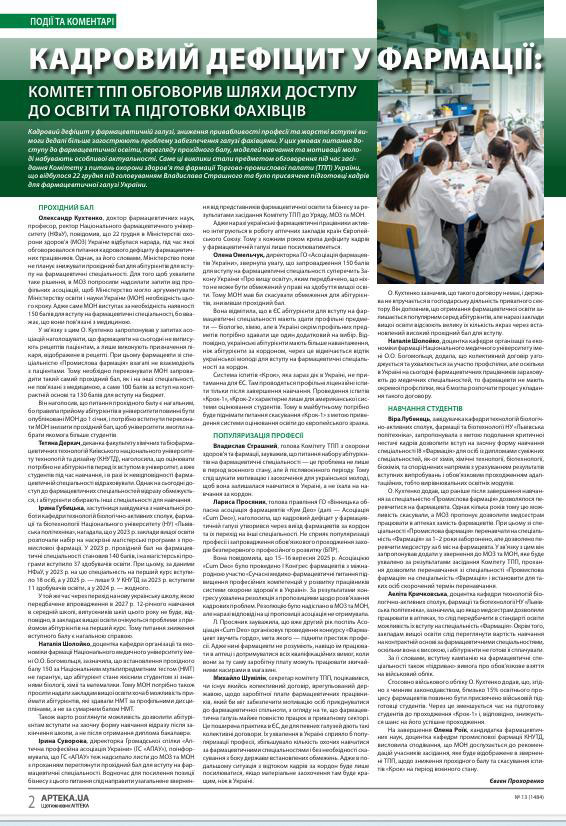
Information about the meeting and the key positions of its participants was also published by the specialized industry outlet Apteka, which highlighted the issue of workforce shortages in the pharmaceutical field and the initiatives developed within the activities of the Healthcare and Pharmacy Committee of the Ukrainian Chamber of Commerce and Industry.
26.12.2025